In modern research environments, equipment uptime is more than an operational concern; it directly influences scientific throughput, data quality, and the ability of teams to meet aggressive project timelines. Every laboratory relies on a wide array of instruments, washers, incubators, environmental chambers, HVAC components, robotic systems, and specialized devices to support its scientific mission. When any of these systems fail, the consequences can be immediate and severe.
One of the most significant yet often overlooked factors affecting equipment uptime is the type of components used inside the equipment itself. Proprietary components and non-proprietary (or commercially standard) components offer fundamentally different experiences in maintenance, repair, sourcing, flexibility, and long-term usability. Understanding the implications of these choices is essential for making informed procurement and lifecycle decisions that protect scientific continuity.
Understanding the Difference Between Proprietary and Non-Proprietary Components
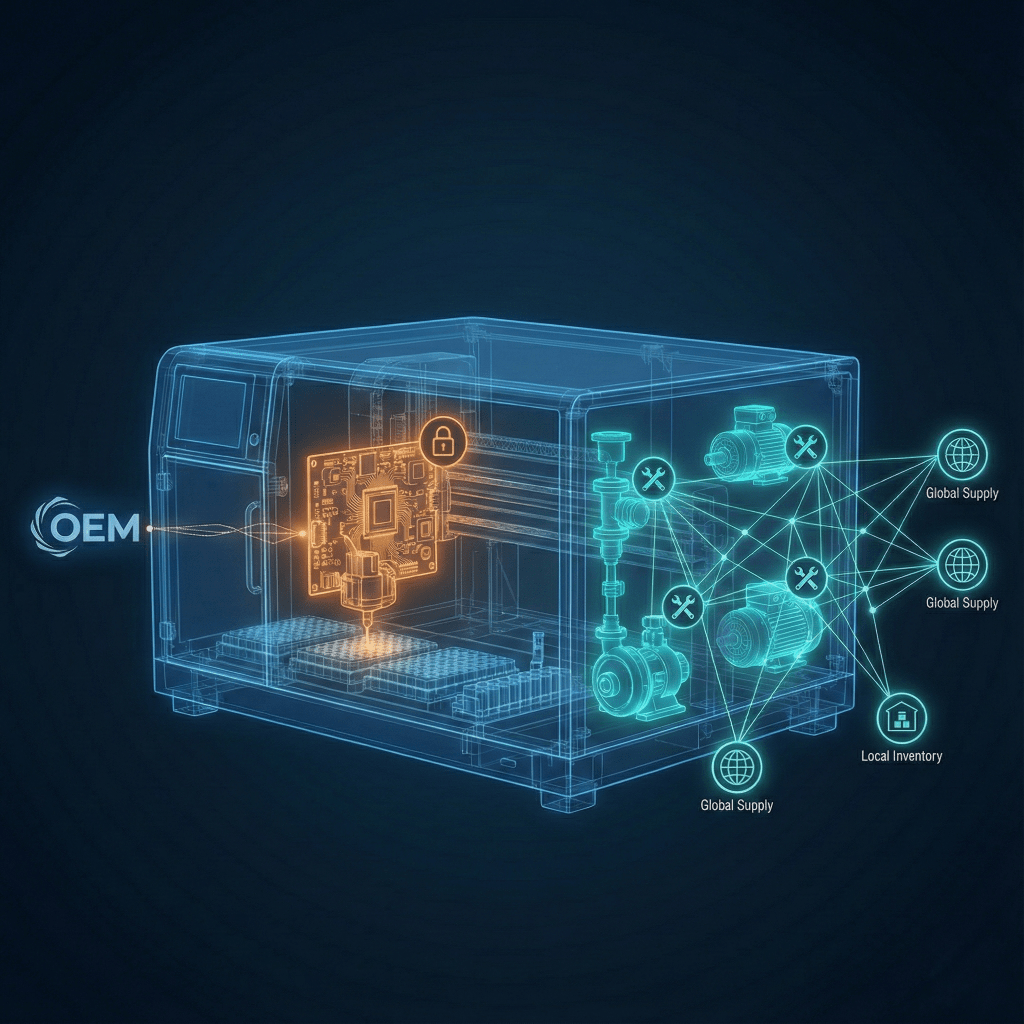
Proprietary components are parts manufactured exclusively by the original equipment maker (OEM) and often designed to work only with a specific model or product line. These include custom circuit boards, unique mechanical assemblies, specialized sensors, and software-restricted modules.
Non-proprietary components, by contrast, use standardized formats or readily available industrial equivalents. These can include off-the-shelf pumps, commercial solenoid valves, common PLCs, universal temperature sensors, or standardized bearings, seals, and drive components.
Each approach has strengths and limitations. The key is aligning component strategy with the operational needs of the lab.
The Reliability and Performance Advantages of Proprietary Components
Proprietary components are often engineered to maximize compatibility, precision, and integration within a specific piece of lab equipment. When designed well, they provide extremely high performance and tight control over critical parameters. For example, OEM-designed thermal sensors, pump modules, or airflow systems may achieve levels of accuracy that generic alternatives cannot replicate.
Proprietary components also support:
- Seamless integration with the equipment’s software
- Consistent performance across units
- Simplified calibration and quality control
- A cohesive ecosystem for interconnected equipment
For labs with highly specialized workflows or equipment requiring exceptional sensitivity, proprietary components may offer advantages in performance and reliability.
The Operational Risks and Limitations of Proprietary Components
Despite their benefits, proprietary components introduce significant risks, risks that directly affect equipment uptime and scientific continuity.
The most common challenges include:
- Long lead times for replacement parts
- High replacement costs
- Vendor lock-in that prevents competitive sourcing
- Limited availability for older models
- Inability to substitute readily available alternatives
- Delays caused by supply chain disruption
When proprietary components fail, labs often face extended downtime because only the OEM can supply or service the part. For research environments that depend on continuous operation, such as vivarium washers, environmental rooms, or genomics workflows, these delays can halt science entirely.
The Flexibility and Resilience of Non-Proprietary Components
Non-proprietary components provide a fundamentally different strategic advantage: flexibility. Because these parts are widely available from multiple suppliers, they offer faster replacement, lower cost, and greater control over repair and maintenance schedules.
Benefits of non-proprietary design include:
- Rapid sourcing from local or global suppliers
- Lower replacement and repair costs
- Reduced dependency on a single vendor
- Greater adaptability when equipment ages or workflows evolve
- Increased ability to troubleshoot using standard tools and technicians
- Enhanced resilience against manufacturer discontinuations
This flexibility translates directly into operational resilience. When a standard sensor, valve, or mechanical part fails, technicians can source replacements within hours, not weeks, keeping critical systems online and science moving forward.
Balancing Precision With Practicality
Not every component can or should be non-proprietary. Highly specialized scientific instruments often require custom elements to achieve necessary performance thresholds. The challenge is finding the right balance between precision and practicality.
The best long-term strategies often include:
- Selecting equipment with commercially available wear components
- Ensuring proprietary elements are limited to truly essential functions
- Confirming parts availability over the expected lifespan of the equipment
- Understanding true total cost of ownership beyond purchase price
- Evaluating the vendor’s long-term support history
- Prioritizing transparency in service documentation and component sourcing
When labs evaluate equipment based not only on purchase cost but also on maintainability and lifecycle accessibility, they make choices that protect operational continuity.
Empowering Preventive Maintenance and Reducing Downtime
Equipment designed with serviceability in mind, often made possible through non-proprietary or partially standardized components, empowers technicians to maintain systems proactively and respond quickly when issues arise.
This enables:
- Faster preventative maintenance cycles
- Greater accuracy in troubleshooting
- More predictable repair timelines
- Decreased dependence on specialized service teams
- Reduced downtime during failures
- Enhanced ability to keep workflows uninterrupted
In environments such as vivariums, where washer or HVAC downtime has immediate animal welfare and operational implications, the ability to quickly service equipment becomes a critical success factor.
Supporting the Future of Integrated and Automated Labs
As labs adopt more automation, robotics, and fully integrated digital systems, the need for uptime becomes even more pronounced. Automated workflows cannot tolerate extended periods of equipment outage, and a single failure can halt interconnected systems.
Selecting equipment with accessible, serviceable components ensures:
- Better long-term compatibility
- Greater flexibility for upgrades
- Reduced risk of obsolescence
- More predictable integration with building and workflow automation
- A stable foundation for scaling scientific operations
Non-proprietary and hybrid-design equipment ensure that labs remain adaptable even as technology advances.
Final Thoughts
The choice between proprietary and non-proprietary components is ultimately a choice about control, resilience, and the ability to keep science moving without interruption. Proprietary components can offer exceptional performance, but they often tie the lab to a single vendor and introduce significant risk if parts fail or become unavailable. Non-proprietary components, by contrast, provide flexibility, rapid serviceability, and a safeguard against disruptions that can halt critical research.
In an environment where uptime, reliability, and continuity are essential, labs must evaluate equipment not only for what it does today, but for how it will perform, and how quickly it can be repaired, for years to come. Equipment design choices can either protect or jeopardize scientific progress. Choosing wisely ensures that research remains uninterrupted, productive, and ready for whatever comes next.
 Ventures Done