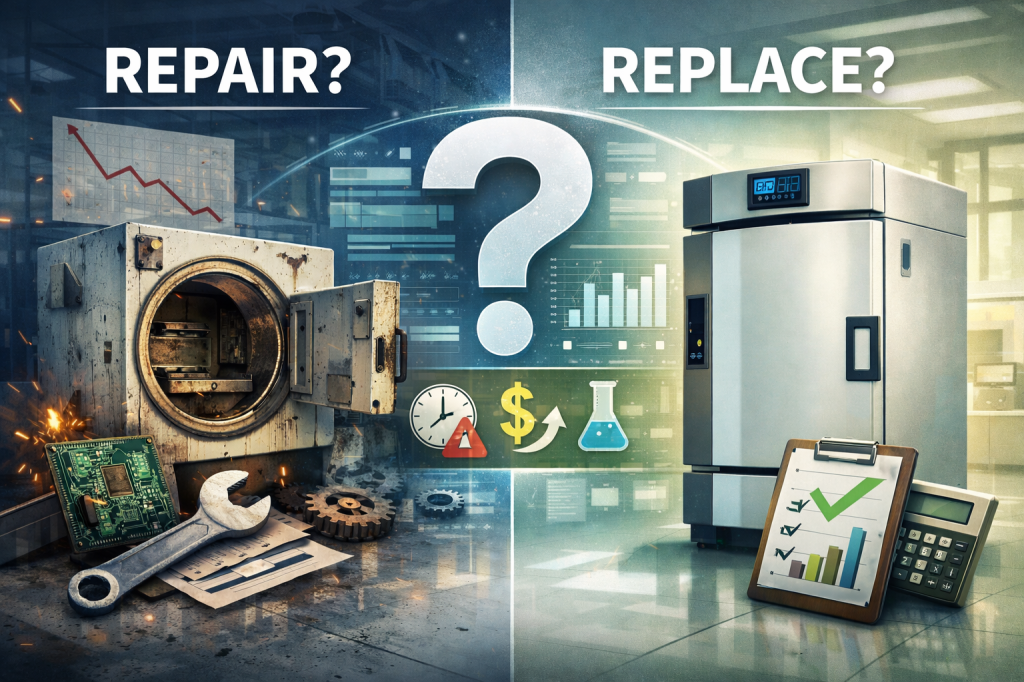
Laboratory equipment is expected to perform reliably for years, often well beyond its original design life. Washers, autoclaves, environmental chambers, HVAC components, and automation platforms are frequently pushed to operate continuously under demanding conditions. As these systems age, facilities teams are repeatedly faced with the same question: should the equipment be repaired again, or is it time to replace it?
This decision is rarely straightforward. Repairing aging equipment may appear cost-effective in the short term, while replacement requires capital planning, procurement lead time, and operational disruption. However, relying solely on upfront cost often leads to decisions that increase long-term risk, downtime, and total cost of ownership. A structured, data-driven approach allows labs to make decisions that protect uptime, scientific continuity, and long-term operational stability.
Understanding the True Cost of Repair
Repairs are often viewed as isolated events, but in reality they are part of a broader trend. As equipment ages, failures tend to become more frequent, parts become harder to source, and service windows grow longer. What begins as an occasional repair can quietly turn into chronic instability.
True repair cost includes not only labor and parts, but also lost productivity, rescheduled experiments, staff time spent troubleshooting, and downstream impacts to connected systems. In highly integrated labs, a single failure can halt entire workflows, amplifying the real cost far beyond the invoice for service.
Evaluating repair history over time provides critical insight into whether equipment is still operating within an acceptable risk envelope or approaching the end of its practical life.
Evaluating Performance and Reliability Trends
One of the most valuable indicators in a repair versus replace decision is performance consistency. Equipment that requires frequent recalibration, exhibits drift, or produces variable outcomes may technically still function, but no longer support reliable science.
Tracking trends such as repeat failures, declining throughput, increased alarm events, and environmental instability reveals whether equipment is degrading structurally or functionally. When performance becomes unpredictable, replacement often becomes the lower-risk option, even if repair costs appear manageable on paper.
Reliability is not just about whether equipment runs, but whether it runs consistently under real operating conditions.
Parts Availability and Long-Term Support Risk
As equipment ages, access to replacement parts becomes a growing concern. Manufacturers may discontinue components, shift product lines, or extend lead times as systems fall out of active production. This introduces a risk that cannot be mitigated by maintenance alone.
When critical components are proprietary or no longer stocked, a relatively minor failure can result in weeks or months of downtime. In research environments where continuous operation is essential, this level of risk often outweighs the cost of replacement.
Assessing vendor support commitments, component availability, and service accessibility is a key part of determining whether repair remains a viable strategy.
Downtime Risk and Scientific Impact
Downtime affects more than schedules. It impacts data integrity, disrupts teams, and creates uncertainty across research programs. In vivarium environments or automated workflows, downtime can have cascading consequences that extend well beyond the failed asset.
Replacement decisions should factor in not just frequency of downtime, but severity. Equipment that fails rarely but catastrophically may pose greater risk than systems with minor, predictable issues. Understanding failure modes and their impact on science is essential when weighing repair against replacement.
Total Cost of Ownership as the Decision Framework
The most effective repair versus replace decisions are grounded in total cost of ownership. This includes capital cost, service expenses, downtime impact, energy consumption, staffing burden, and long-term reliability.
Replacement often provides improved efficiency, better integration with modern systems, enhanced monitoring, and reduced maintenance burden. When evaluated over the remaining life of the asset, replacement can frequently be the more economical and lower-risk option.
A data-driven approach replaces intuition with clarity and allows labs to justify decisions with confidence.
Final Thoughts
Repair versus replace decisions should never be reactive or based solely on immediate cost. By evaluating performance trends, repair history, downtime risk, parts availability, and total cost of ownership, laboratories can make informed decisions that protect scientific continuity and operational stability.
The right choice is not always replacement, but when replacement is needed, making the decision early prevents prolonged disruption and hidden costs. Strategic lifecycle planning ensures that lab infrastructure supports science rather than standing in its way.
 Ventures Done