Laboratory equipment is often evaluated based on performance specifications, footprint, and purchase price. While these factors are important, they represent only part of the equation. Over the life of an asset, serviceability often becomes the defining factor in whether equipment supports or hinders scientific operations.
Serviceability determines how quickly equipment can be maintained, repaired, and returned to service. In environments where uptime is critical and workflows are tightly integrated, this characteristic has a direct impact on productivity, risk, and total cost of ownership.
Serviceability Shapes Long-Term Reliability
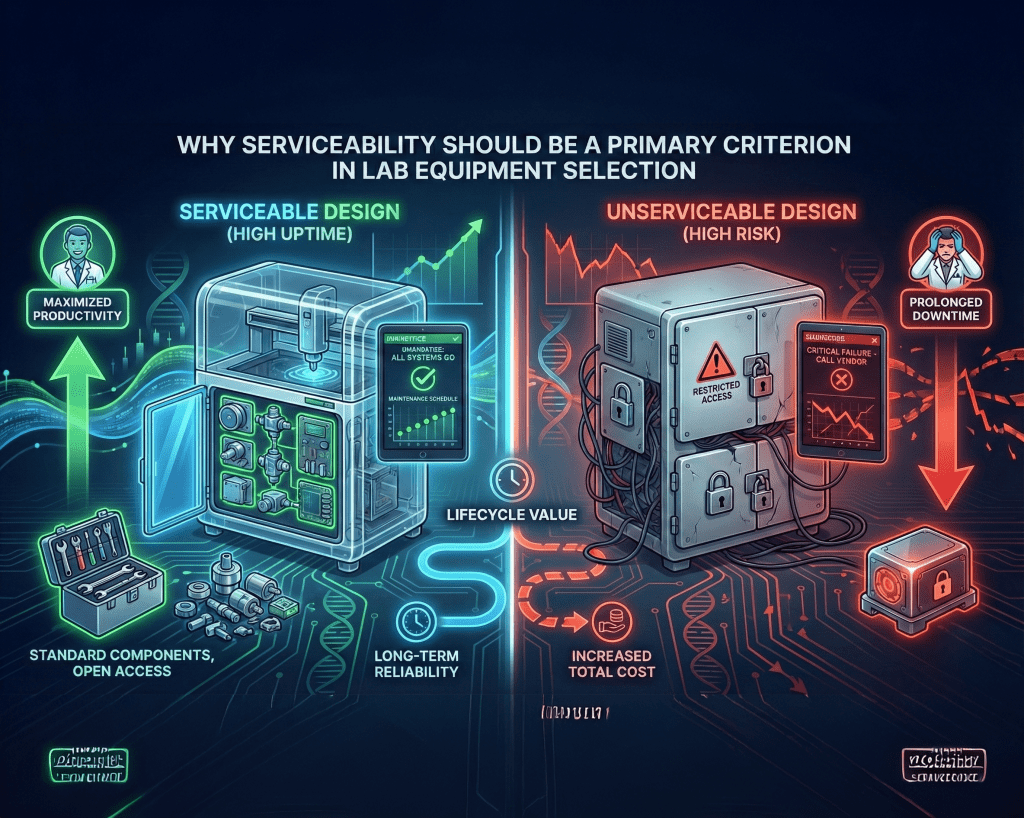
Equipment that is difficult to access, diagnose, or repair inevitably experiences longer downtime. Complex disassembly, proprietary diagnostics, or restricted parts availability extend service windows and increase dependency on specialized technicians.
By contrast, equipment designed with serviceability in mind allows maintenance tasks to be performed efficiently and predictably. Clear access points, standard components, and transparent diagnostics enable faster response and more effective preventative maintenance.
Over time, this difference has a measurable impact on reliability and operational confidence.
Downtime Is Often a Function of Design, Not Failure
Many prolonged outages are not caused by catastrophic failures, but by simple components that are difficult to reach or replace. A failed sensor, valve, or actuator can take days to resolve if access is limited or parts are unavailable.
Serviceable designs reduce this risk by anticipating real-world maintenance needs. Equipment that supports straightforward troubleshooting and rapid component replacement minimizes downtime even when failures occur.
Design choices made at procurement directly influence how disruptive future failures will be.
Supporting Preventative Maintenance Programs
Preventative maintenance is only effective when it can be executed consistently. Equipment that is difficult to service often leads to deferred maintenance, skipped inspections, or incomplete tasks.
Serviceable equipment supports proactive care by making routine maintenance practical rather than burdensome. This leads to better adherence to maintenance schedules, earlier detection of issues, and longer equipment life.
Preventative maintenance and serviceability are inseparable in high-performing lab environments.
Reducing Dependence on Single Vendors
Highly proprietary designs often limit service options to the original manufacturer. This can create scheduling constraints, higher service costs, and vulnerability to supply chain disruptions.
Equipment that uses standardized components and open architectures allows facilities to maintain flexibility. Multiple service providers, readily available parts, and internal maintenance capability all contribute to faster recovery and reduced risk.
Operational freedom becomes increasingly valuable as equipment ages and priorities evolve.
Enabling Scalability and Integration
As labs expand and integrate new technologies, serviceability becomes even more important. Automated workflows, interconnected systems, and building management integration amplify the impact of downtime.
Equipment that can be maintained efficiently supports scalability by reducing operational friction. Serviceable systems are easier to integrate, upgrade, and adapt without prolonged disruption.
Final Thoughts
Serviceability is not a secondary consideration. It is a core determinant of whether lab equipment delivers long-term value. Equipment that is easy to maintain, repair, and support reduces downtime, lowers risk, and strengthens preventative maintenance programs.
By prioritizing serviceability during equipment selection, labs protect scientific continuity and create environments that remain resilient long after installation. In modern research facilities, the ability to keep equipment running matters just as much as what that equipment can do.
 Ventures Done