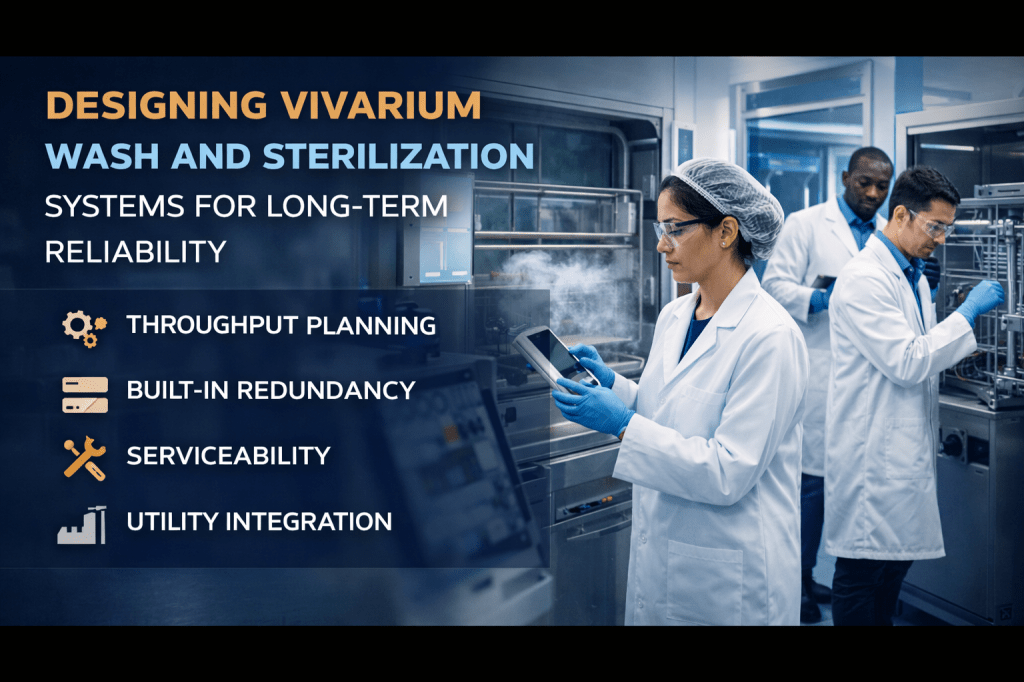
Wash and sterilization systems are among the most critical components of vivarium operations. Cage washers, rack washers, and autoclaves operate continuously to support sanitation, biosecurity, and animal welfare. When these systems underperform or fail, the consequences are immediate and far-reaching.
Designing these systems for long-term reliability requires more than selecting equipment with sufficient capacity. It requires careful consideration of throughput, redundancy, maintenance access, and integration with supporting utilities.
Throughput Planning Beyond Initial Demand
Vivarium demand rarely remains static. Program growth, species changes, and protocol adjustments all influence wash and sterilization requirements over time. Systems designed only for initial demand quickly become stressed as utilization increases.
Reliable designs incorporate capacity margins that allow for peak loads, maintenance downtime, and future expansion. Throughput planning should account for realistic operating schedules, not just theoretical maximums.
Redundancy as a Reliability Strategy
Redundancy is essential in vivarium environments. Single points of failure in wash or sterilization systems can halt operations entirely. Redundant equipment, utilities, or workflows provide flexibility when maintenance or repairs are required.
Even partial redundancy, such as the ability to shift loads between systems, significantly improves resilience and reduces emergency response pressure.
Maintenance Access and Serviceability
Reliability depends on the ability to maintain equipment effectively. Systems designed without adequate service access often experience deferred maintenance, longer repairs, and increased downtime.
Clear access to components, logical layouts, and service-friendly designs enable routine maintenance and rapid troubleshooting. Over time, these design choices have a major impact on uptime and operational confidence.
Utility Integration and Environmental Considerations
Wash and sterilization equipment place significant demands on utilities, including water, steam, electrical power, and HVAC. Poor integration can lead to inconsistent performance, increased wear, and energy inefficiency.
Designing systems with proper utility capacity, heat rejection management, and airflow coordination ensures stable operation and extends equipment life.
Planning for the Full Equipment Lifecycle
Long-term reliability requires thinking beyond installation. Parts availability, service support, and upgrade paths all influence how systems perform over time. Equipment selection should consider not just current performance, but how systems will be maintained and supported years into the future.
Final Thoughts
Reliable vivarium wash and sterilization systems are the result of thoughtful design, not just equipment selection. By planning for throughput variability, incorporating redundancy, prioritizing serviceability, and integrating utilities effectively, facilities can create systems that support continuous operations and protect animal welfare.
Long-term reliability begins at the design stage.
 Ventures Done